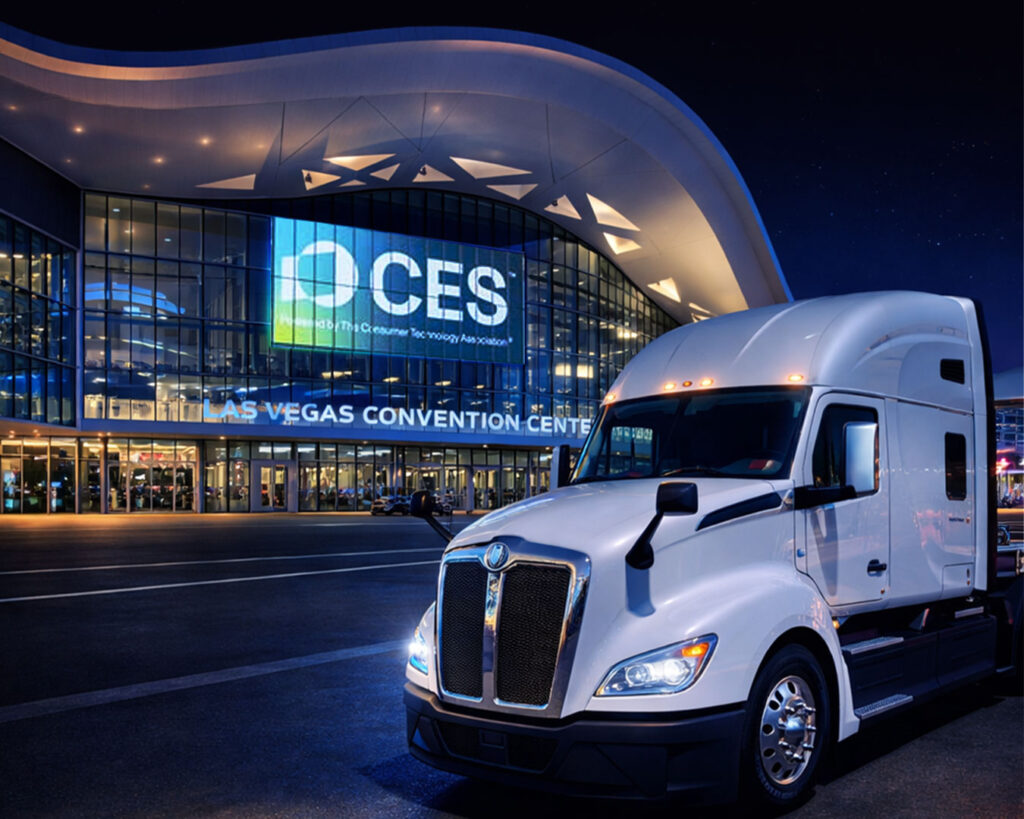
Every January, Las Vegas becomes a temporary capital of innovation. Lights go up, exhibit booths fill with visitors, and new products take the spotlight.
But CES does not begin with keynote speeches or product reveals. It begins with transportation schedules, dock appointments, staging zones for trucks, and tightly controlled delivery windows.
CES 2026 took place from January 6 to January 9 in Las Vegas, bringing in thousands of shipments that had to arrive safely, on time, and in the correct sequence.
So how many trucks does CES take?
There is no single number, because freight arrives in waves from every direction. But one thing is certain: for every “wow” moment on the show floor, there is a logistics operation behind the scenes making it possible.
Most logistics challenges during major events come down to one word: deadlines.
CES has a strict move-in schedule, exhibit halls have limited dock capacity, and exhibitors face fixed setup timelines. If a shipment arrives late, a booth may not be ready when the doors open.
That pressure turns regular transportation into time-critical freight, even when the shipment looks simple on paper. And unlike standard warehouse deliveries, CES is not a “pull in and unload” operation. Everything depends on controlled access, precise timing, and coordination.
1) It is not just “deliver to the convention center”
Exhibitors typically choose one of two shipping paths:
Option A: Ship to an Advance Warehouse
Freight arrives early, stays secured, and moves into the venue on schedule. This adds a buffer against delays and reduces last-minute risk.
Option B: Ship Direct-to-Show
Freight arrives closer to showtime. It can be faster or cheaper, but it is riskier. Trade show deliveries often involve strict check-in windows, long queues, limited dock access, and a higher chance of detention (truck wait time).
2) Marshalling yards: where trucks check in and wait
Here is something many people do not realize: at major trade shows, trucks often cannot go straight to a dock and unload.
Instead, carriers may need to check in at an offsite marshalling yard, a staging area where shipments are organized and released in the correct order as dock space becomes available.
This system prevents gridlock at the venue, but it can also create delays even when the truck arrives “on time.” Trade show delivery is not only about transit time. It is also about access, scheduling, and timing.
3) Drayage: the final move that surprises many exhibitors
Even when the trailer reaches the venue, the process is not over.
At most large trade shows, the final movement of freight is handled by material handling teams. This process is known as drayage.
Drayage includes unloading at the receiving dock, internal transport to the booth, storing empty crates, and returning freight for outbound shipping after the show. It is also one of the most misunderstood parts of trade show logistics, and a cost factor that should be planned upfront.
CES freight is not just boxes of consumer tech. Many shipments include booth structures, display panels, LED walls, AV equipment, lighting systems, demo units, prototypes, signage, fixtures, and installation tools.
Much of this freight is fragile, high-value, and extremely time-sensitive. One damaged crate can delay a build. One missed window can disrupt an entire booth schedule.
CES proves a simple truth: the bigger and more visible the event, the more invisible logistics it requires.
Las Vegas becomes a freight hotspot during CES because everything hits at once: tight deadlines, restricted access, high shipment volume, complex handling, and high-value freight.
At KSM Carrier Group, we understand that many shipments are not “just freight.” They are deadlines in motion.
We are an asset-based, family-owned carrier serving the contiguous United States, with dry van and refrigerated capacity. When timing, communication, and reliability matter most, shippers need a partner who keeps freight moving and provides consistent updates every step of the way.
If your next shipment requires tight delivery windows, careful handling, clear communication, and dependable capacity across lanes, these are the same fundamentals that keep major events like CES running on schedule